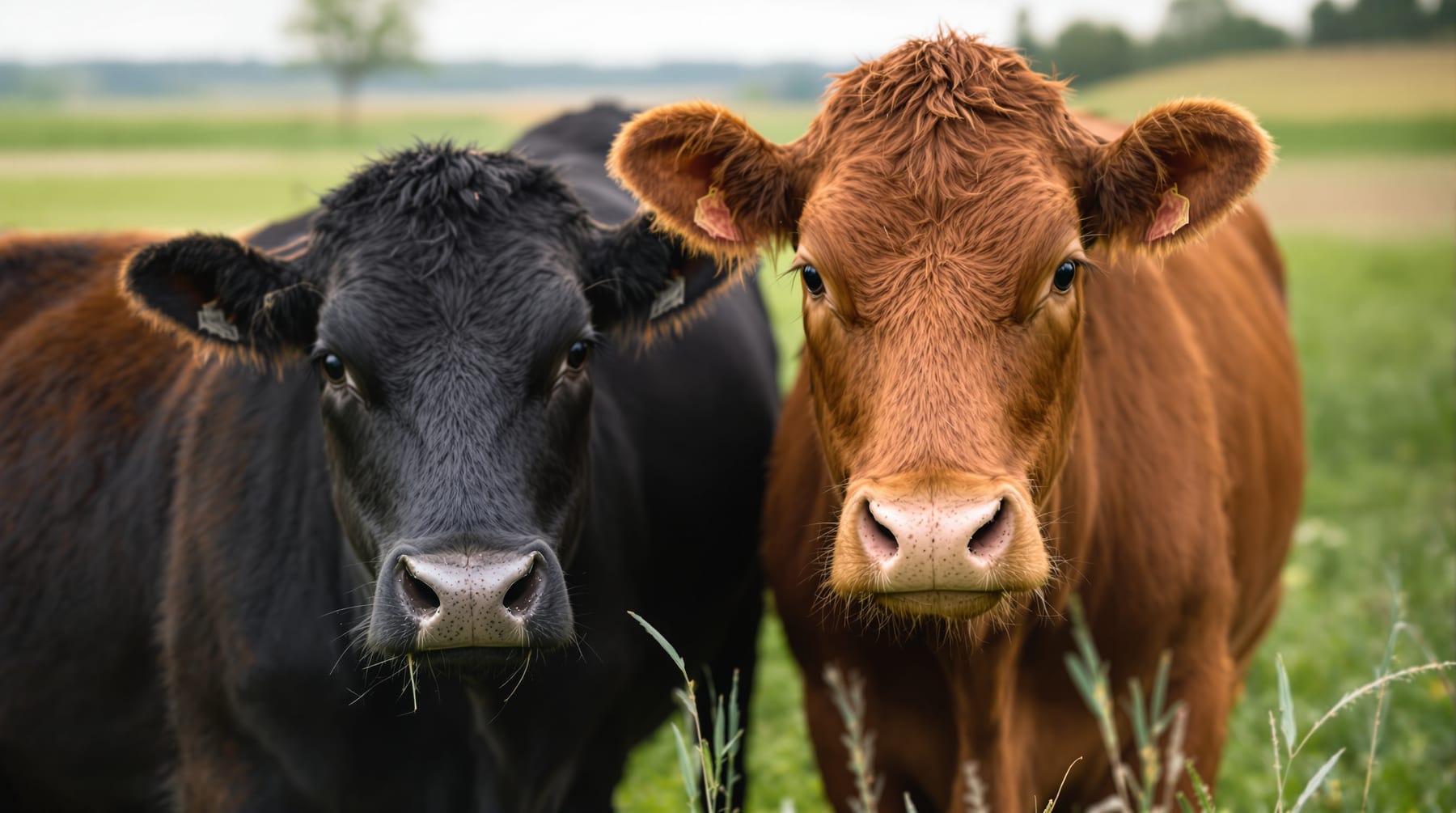
Canada registers Red and Black Angus in a single herd book. It is one of the quiet structural facts that makes the Canadian purebred sector work differently from the American one, and it is worth understanding before reading any sale catalogue.
The colour is one gene
Coat colour in Angus cattle is controlled at the extension locus. Black is dominant; red is recessive. An animal is red only when it inherits the red allele from both parents, which means a black animal may carry red without showing it, and two black parents can produce a red calf. Nothing else travels with that gene. Frame, milk, calving ease, marbling and temperament are inherited independently of colour, and a red animal is not a different kind of cattle beast from a black one.
That single-gene inheritance is why colour can be tested rather than guessed. Commercial DNA panels report red-carrier status alongside parentage verification and genomic predictions, so a purebred breeder selling black bulls into a herd that wants no red calves can say with certainty which bulls are homozygous black.
One herd book in Canada
The Canadian Angus Association registers both colours in the same herd book and issues pedigrees on the same basis. In the United States the two are administered by separate associations. The practical consequences of the Canadian arrangement show up everywhere:
- A single Canadian operation can and often does run both colours under one prefix and one membership.
- Sale catalogues routinely list red and black lots together, with colour treated as one line item among many rather than as a category boundary.
- Performance data is pooled, so genetic evaluations are calculated across a larger population than either colour alone would provide.
- Provincial shows classify by colour in the ring while the underlying registrations sit in the same book.
Where the colours came from
Red animals appeared in Aberdeen-Angus herds from the beginning; the Scottish foundation stock carried the recessive. For much of the twentieth century they were culled or quietly sold commercially because the show standard favoured black. The rehabilitation of Red Angus as a registered colour, in Canada within the existing association and in the United States through a separate one, recovered genetics that had been selected against for reasons that had nothing to do with performance.
Does colour matter commercially?
It matters for two reasons, neither of them biological.
Branded programmes. Several North American branded-beef programmes use hide colour as a first screening criterion, which advantages black-hided cattle at the packer regardless of the animal's actual genetics. That is a specification, not a quality measure, and it is the single largest source of price difference attributable to colour.
Heat and hide. Red cattle absorb less solar radiation, which is a genuine advantage in hot climates and a negligible factor through an Alberta winter. In this province the argument cuts less than it does further south.
For a commercial buyer in Alberta the honest summary is that colour should be well down the list. Calving ease, growth, maternal traits and docility are all measured, all heritable, and all more consequential than the extension locus. Our breed characteristics page sets out what those measures are.
Reading a catalogue
A Canadian Angus catalogue entry will typically carry registration number, prefix and tattoo, birth date, sire and dam with their own registrations, a set of expected progeny differences with accuracy values, genomic-enhanced flags where testing has been done, and colour or red-carrier status. The colour line is the least informative thing on the page. The accuracy values attached to the EPDs are the most informative, and they are the part most often skipped.
The Beef Cattle Research Council publishes plain-language material on interpreting genetic evaluations, and it is the best starting point for a commercial producer buying purebred bulls for the first time.
Crossbreeding and the recessive
Because red is recessive, colour behaves predictably in a crossbreeding programme and can be used as a rough management tool. A homozygous black bull on a red-based cow herd produces uniformly black calves; a red bull on a red herd breeds true. Producers who market into a black-hide programme sometimes use that predictability deliberately, testing bulls for carrier status rather than guessing from appearance.
The trap is letting a single-gene management convenience drive the whole selection decision. A homozygous black bull with mediocre calving ease is still a mediocre calving-ease bull, and the calves will be uniformly black and uniformly difficult. Colour is a filter to apply last, after the traits that actually pay have been sorted.
In the Alberta herd
Both colours are common across the province, with red concentrated slightly more heavily in the south and southeast and black dominant in the parkland, though the pattern is soft and driven more by individual programmes than by geography. The regional guide covers the geography; the show and sale year covers when the bulls actually change hands.