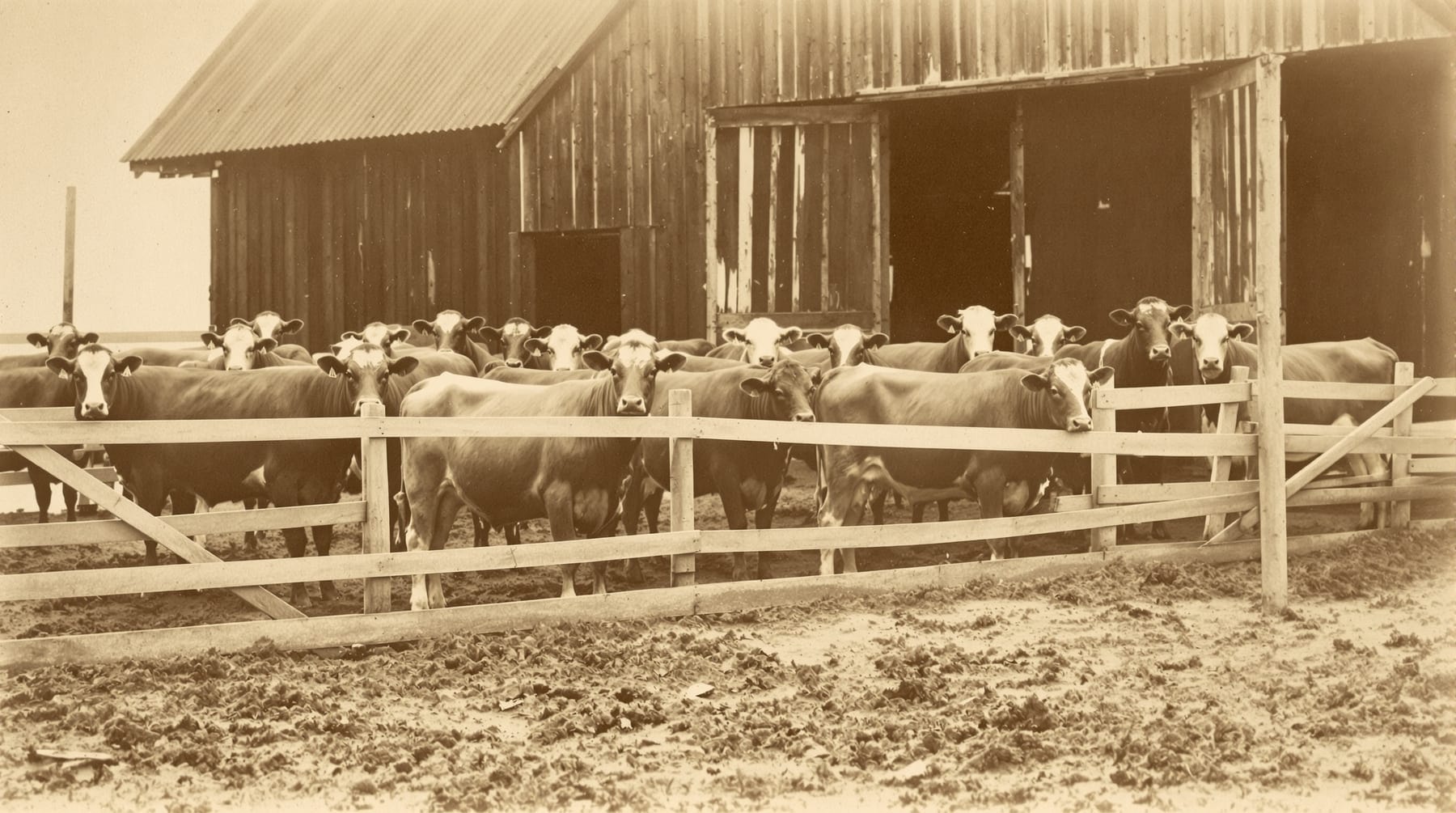
The Angus record in Canada is unusually well documented, partly because the breed's registry work began early and partly because a fire forced the registry to be reassembled from breeders' own papers. What follows is the documented sequence, drawn from the Canadian Angus Association and from Canadian Angus History Update by Lloyd Pickard.
Arrival in Canada, 1859–1877
Angus animals reached Montreal by 1860, and some landed in Victoria, British Columbia in 1874. The first recorded importation was in 1859 by Sir George Simpson, Governor of the Hudson's Bay Company. No progeny was recorded from it, so credit for the first productive importation went instead to Professor William Brown at the Ontario Experimental Farm in Guelph.
The first of the breed born in North America is commemorated on a bronze plaque in Guelph, recognising the birth of Eye Bright 2nd on 12 January 1877, sired by the bull Gladiolus. It is a small monument for a large consequence: nearly every Angus animal in the country descends from imports made in the two decades on either side of it.
The 1880s imports and the naming of Cochrane
In 1882 some 323 Angus were imported from Scotland. The most consequential of those importers, from an Alberta point of view, was the Hon. M. H. Cochrane, who had his headquarters in Montreal and a ranch in Alberta. In 1881 he bought ten animals from Scotland for the extraordinary sum of $9,975 — in an era when a top bull sold for around $300. The town of Cochrane, just west of Calgary, takes its name from that early promoter of Aberdeen-Angus cattle.
That detail is worth pausing on. It is easy to read the Alberta cattle industry as a Hereford story that Angus later joined; in fact Angus money was in the province from the very first years of large-scale ranching, and the breed's presence on the western range is as old as the range itself.
The herd book, the fire, and nationalisation
By 1884 the Dominion Polled Angus Herd registry had been established in Toronto. Ten years later, in 1894, a fire destroyed all the Aberdeen-Angus manuscripts. Circulars went out to every breeder asking them to send in whatever pedigrees they held so the records could be rebuilt. A large number came back; many others were lost for good, and the gaps in the early Canadian record date from that fire rather than from any failure of record-keeping since.
In 1905 the records were nationalised and the recording office moved from Toronto to Ottawa. Breeders formed the Canadian Aberdeen Angus Association, incorporated under the Dominion Act respecting Livestock Records Associations. The new association made a decision that still shapes the Canadian herd book: it declined to recognise the old herd register and instead required every living animal to be registered afresh.
Every animal put forward had to pass a standard inspection by an authorised inspector, Mr. James Bowman of Guelph, with expenses paid by the Department of Agriculture. Bowman reviewed the records and pedigrees of all Angus cattle in Canada and supplied the data for the first Canadian Aberdeen Angus Herd Book, published in 1908. The modern registry run by the Canadian Angus Association is the direct continuation of that volume.
The Alberta Aberdeen-Angus Association, founded 1917
Mr. Kenneth McGregor, Professor of Animal Husbandry at the University of Alberta, called a meeting of Alberta Aberdeen-Angus breeders at the university on 24 January 1917 for the purpose of forming an association. Mr. J. J. Bell of Islay was elected chairman of the meeting and Mr. F. R. Cathro of Calgary secretary. The officers and directors elected were:
1917
- Honorary President: Dean Howes, University of Alberta
- President: G. H. Hutton, Lacombe
- First Vice-President: W. J. Reid, Innisfail
- Second Vice-President: Chas. Ellett, Strathcona
- Secretary: F. R. Cathro, Calgary
- Directors: A. Noad, Olds; L. McComb, Huxley; Lew Hutchinson, Duhamel; F. Messervy, Lougheed; J. C. Bell, Morningside; C. R. Morton, Vegreville
1918
- Honorary President: Dean Howes, University of Alberta
- President: G. H. Hutton, Lacombe
- First Vice-President: Chas. Ellett, Strathcona
- Second Vice-President: J. J. Bell, Islay
- Secretary: N. F. Bell, University of Alberta
- Directors: A. Noad, Olds; L. McComb, Huxley; Lew Hutchinson, Duhamel; F. R. Cathro, Calgary; S. G. Cowan, Delia; J. F. Day, Red Deer
By 18 March 1918 a total of 29 breeders had paid their dues to the Alberta association — and two of them, Mr. Ken McGregor of Brandon, Manitoba and Mr. M. A. Spottiswood of Tompkins, Saskatchewan, were not Albertans at all. Read the town names in those two lists and you have a map of where the breed took hold: Lacombe, Innisfail, Olds, Huxley, Duhamel, Vegreville, Red Deer, Delia. That is the central parkland and the black-soil belt, and it is still Angus country a century later, as our regional guide sets out.
What happened next
The century after 1917 is the story of a breed moving from the show ring into the commercial herd. Two changes did most of the work. The first was performance recording — weights, then expected progeny differences, then genomic testing — which let commercial buyers select on measured traits rather than appearance. The second was the acceptance of Red Angus into the same national herd book as Black, discussed on our Red and Black Angus page, which kept a single breed rather than splitting it.
Along the way the provincial association added the things a provincial body does: a junior association, 4-H support, scholarships, a newsletter and a set of annual recognitions for long service to the breed. Those are covered under juniors and 4-H, the newsletter record and recognition.
Where the primary record lives
Pedigree and registration records are held by the Canadian Angus Association, which is the only authority on the Canadian herd book. Historical cattle statistics for the province are published by Statistics Canada, and the Agriculture and Agri-Food Canada library holds much of the federal record from the 1905 nationalisation onward.